

Overview
We are excited to announce the latest release of HiddenLayer’s AI Supply Chain Security as part of our continued commitment to providing the industry’s most advanced AI security solution. This latest update introduces a new feature, along with enhancements, that offers an even more robust, intuitive, and effective cybersecurity for your AI experience. The Supply Chain analyzes Machine Learning Models (ML Models) to identify hidden cybersecurity risks and threats, such as malware, vulnerabilities, and integrity issues. See the Supply Chain Deployment Guide for detailed instructions on deployment options, installation, and testing the model scanner.Release Notes for Supply Chain version 26.10.0 released on October 14, 2026.
What’s New
Supply Chain Policy
- You can now add multiple rules to a Supply Chain policy to tailor it to your organization’s needs.
-
The policy now includes:
- Rule Builder: Build a policy rule using attributes, values, and operators.
- Rule Templates: Select a preconfigured policy rule.
- See Supply Chain Policy for more details and instructions.
What’s Improved
Unknown Files
- Unknown files in scans will now report if the file is a binary or an ASCII file.
HDF5 / .keras Support
- Expanded HDF5/.keras support. This includes recently discovered exploits.
Release Notes for Supply Chain Model Tags, which is now generally available, released on October 6, 2026.
What’s New
Model Tagging Now GA
- The Model Tags feature is now generally available (GA).
- See Model Tags for more details.
Release Notes for Supply Chain version 26.9.1 released on September 8, 2026.
What’s New
Model Tagging
Early AccessThe Model Tags feature is Early Access. Ask your HiddenLayer representative for more information.
- Create tags (key-value pairs) for a Model Card. Organize your models to suit your organization’s needs.
- Filter the models using a tag.
- See Model Tags for more details.
Release Notes for Supply Chain version 26.9.0 released on September 1, 2026.
What’s New
File Streaming (SaaS)
- File streaming enables efficient scanning of large model files in SaaS. This functionality reduces the amount of storage required to process large model files.
- SaaS can now scan model files up to 500 GB.
- File streaming is available in SaaS only. It is not supported in the CLI in this release.
Apple Metal Format Identification
- Supply Chain now identifies Apple Metal format files.
What’s Improved
Detection Coverage
- Improved ShadowLogic detections to reduce false positives.
- Additional Keras and TensorFlow detections.
Release Notes for Supply Chain version 26.8.0 released on August 11, 2026.
What’s Improved
Tokenizer Tampering
- Refined Tokenizer Tampering detection for accuracy.
AIBOM via CLI
- Added ability to generate both CycloneDX and JSON AIBOMs at the same time.
- See Command-Line Arguments for more details.
Release Notes for enabling the Evidence for Advisories feature on August 3, 2026.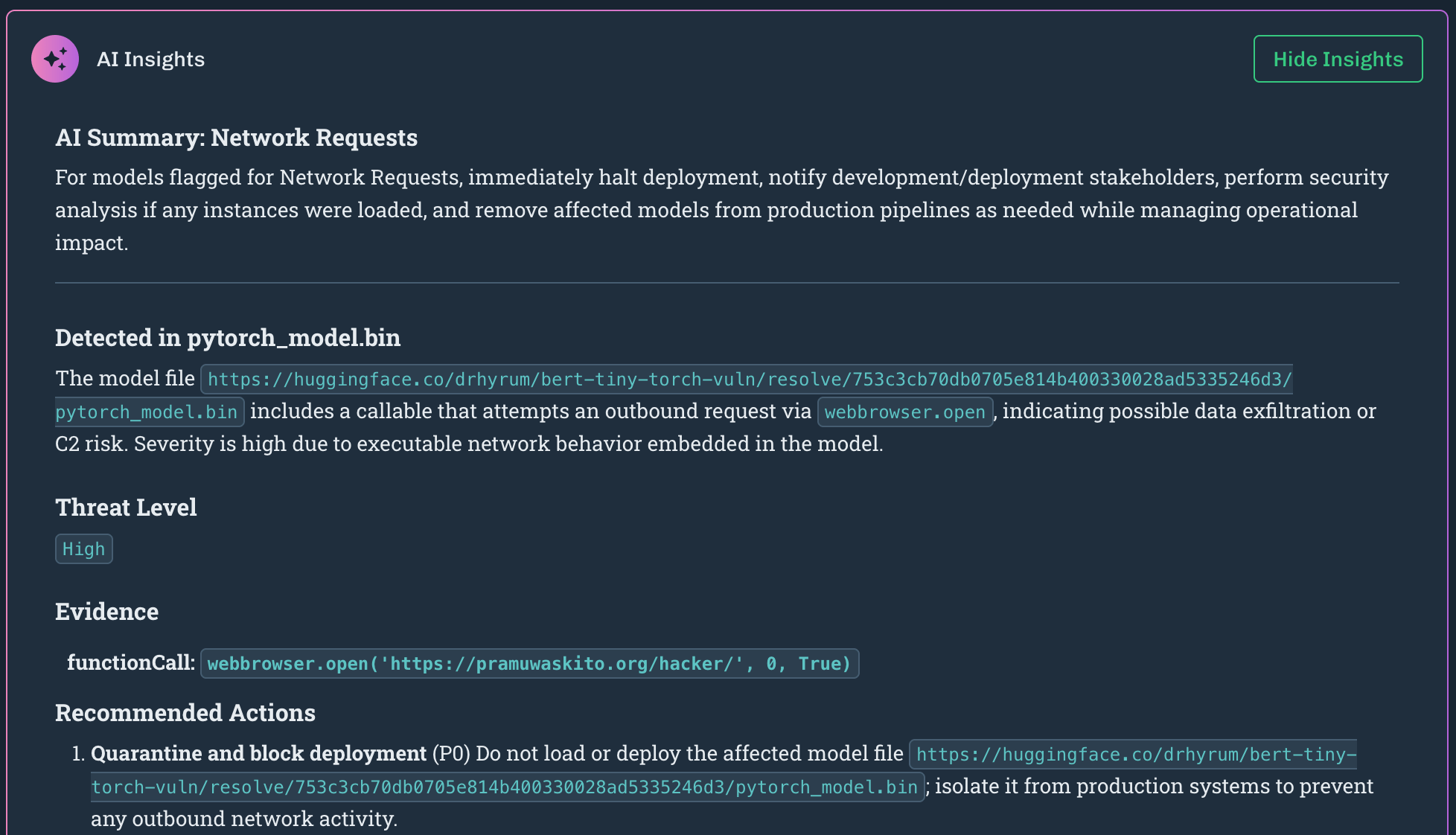
What’s New
Evidence for Advisories
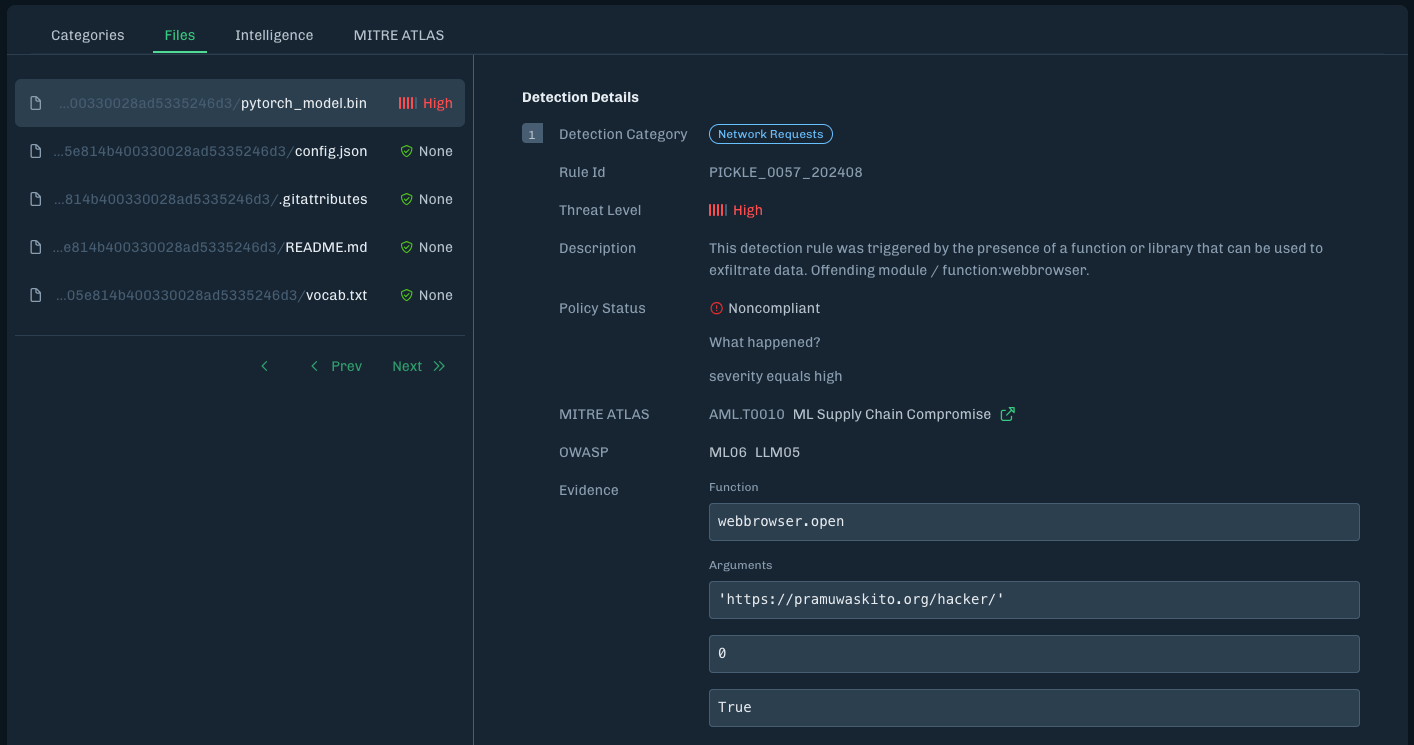
- By adding evidence of the detection to advisories, HiddenLayer is giving the customer additional context when looking to mitigate the advisory. Where evidence is available, HiddenLayer provides the function and arguments leading to the detection.
- Evidence for Advisories can be found as part of the generated AI Insights and under Files > Detection Details (click View More to expand the details).
Release Notes for Supply Chain version 26.6.2 released on July 16, 2026.
What’s Improved
Improved Performance for Numpy and Pickle
- Scanner performance improvements for Numpy and Pickle models.
Known Issue
- Increased model scanning time and memory usage for numpy, pickle, and rds model files in comparison to version 26.5.0.
Release Notes for Supply Chain version 26.6.1 released on July 9, 2026.
What’s Improved
TensorFlow Scans
- Scanner speed improvement on TensorFlow models.
What’s Resolved
Scanning Large Pickle-Based Files
- Fixed a bug in processing large model files in pickle based model types (pickle, pytorch, numpy, nemo).
Known Issue
- Increased model scanning time in comparison to version 26.5.0.
Release Notes for Supply Chain version 26.6.0 released on June 30, 2026.
What’s New
Scanning NVIDIA NIM Images within NVIDIA GPU Cloud (NGC)
-
Models in containers from the NGC repository can be scanned directly using Supply Chain.
- Download artifacts with the NGC CLI and scan them separately
- NIM Container Scanning to scan the container
-
Requirements:
- Image reference format: Use an OCI image reference with the
oci://scheme. This is the required format. - Authentication: Provide an NGC API key for use in the Supply Chain CLI. Set
NGC_API_KEY. - Submit the scan with the full OCI reference as the image location.
- Image reference format: Use an OCI image reference with the
-
Example:
-
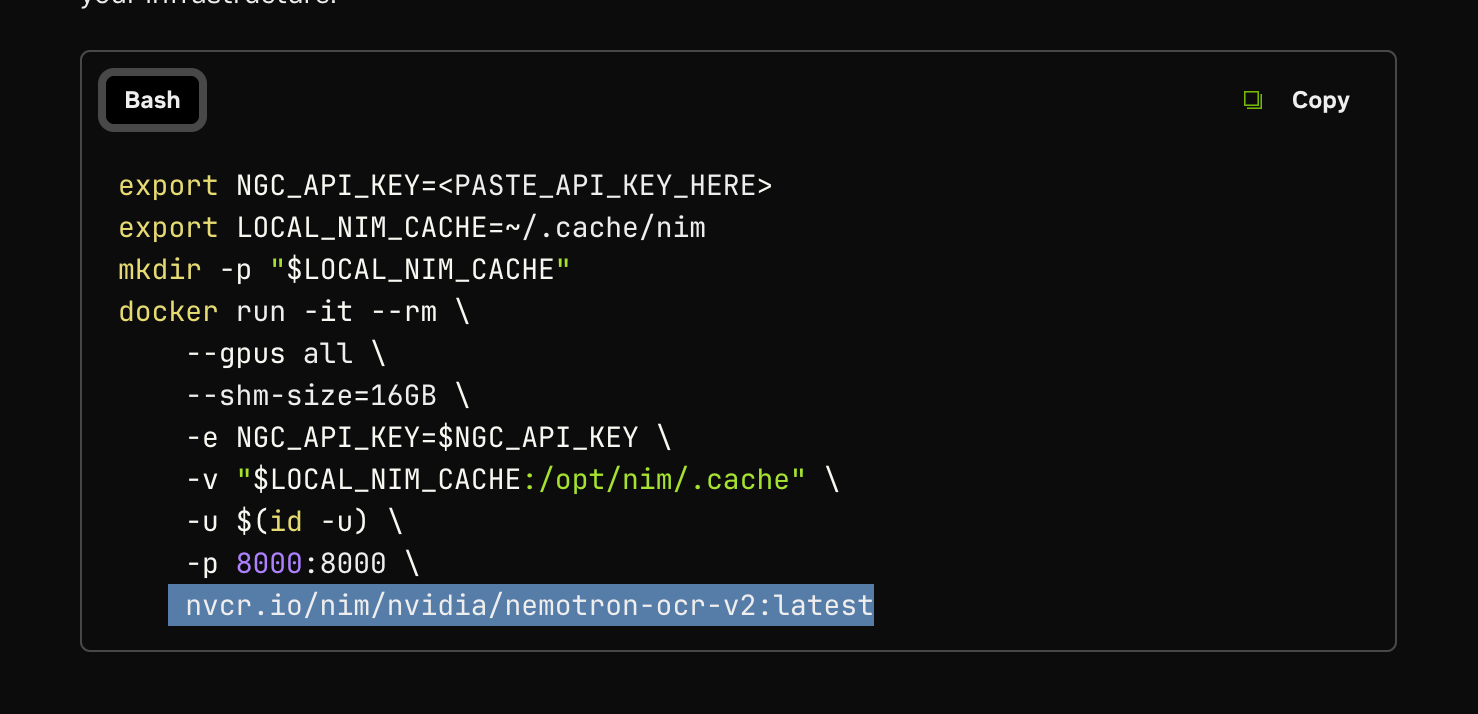
The following image is from NVIDIA’s website and shows an example image path.
-
NOTE: You must add the `oci://“ prefix to the image path. See the example above.
-
NOTE: You must add the `oci://“ prefix to the image path. See the example above.
Scan Gated HuggingFace Repositories
- Models located in gated HuggingFace repositories can now be scanned directly from Community Scan.
- Set up an integration within the platform to configure access to the gated repositories.
- See HuggingFace Gated Repositories Integration for set up instructions.
Things To Be Aware Of
- The Suspicious File Format and Token Break advisories cannot be used when setting policy. Models with these Advisory detections will show as Compliant.
Release Notes for Supply Chain version 26.5.1 released on May 26, 2026.
What’s New
Scanning Models in Containers
- Scanning of models embedded in containers is now available for CLI (self-hosted or hybrid), API, and SaaS.
- Containers must be provided in
.taror.tar.gzformats.
Model IntelligenceModel intelligence enrichment is not available for container scans, at this time.
Potential Long Scan TimesContainers with very high file counts, such as over 100K+ files in a container, can potentially take over an hour to complete scanning.
Release Notes for Supply Chain version 26.5.0 released on May 19, 2026.
What’s New
TokenBreak Advisory
- TokenBreak is now an Advisory within Supply Chain.
Suspicious File Format Advisory
- Suspicious File Format is now an Advisory within Supply Chain.
Shadow Logic
- New Shadow Logic detections.
Detections and Advisories
- Detections - Known exploits exist in the model files. The detections are ranked from Critical to Low severity and can be used to define Supply Chain policy.
- Advisories - Known files of concern, but are not exploits in and of themselves. Advisories should be reviewed prior to model usage.
Release Notes for Supply Chain version 26.4.1 released on May 7, 2026.
What’s New
- Expanding coverage for attack, including infostealer malware like the one recently found in a HuggingFace model. See this HiddenLayer blog post for more information about the recent incident.
Release Notes for migrating Supply Chain images to a different distribution platform on April 13, 2026.
What’s New
- HiddenLayer has changed the container image distribution platform to improve delivering, managing, and supporting deployments.
- Quay is no longer supported. The new method requires version 26.2.0 or newer.
Release Notes for Supply Chain version 26.4.0 released on April 13, 2026.
What’s New
Detection Evidence
-
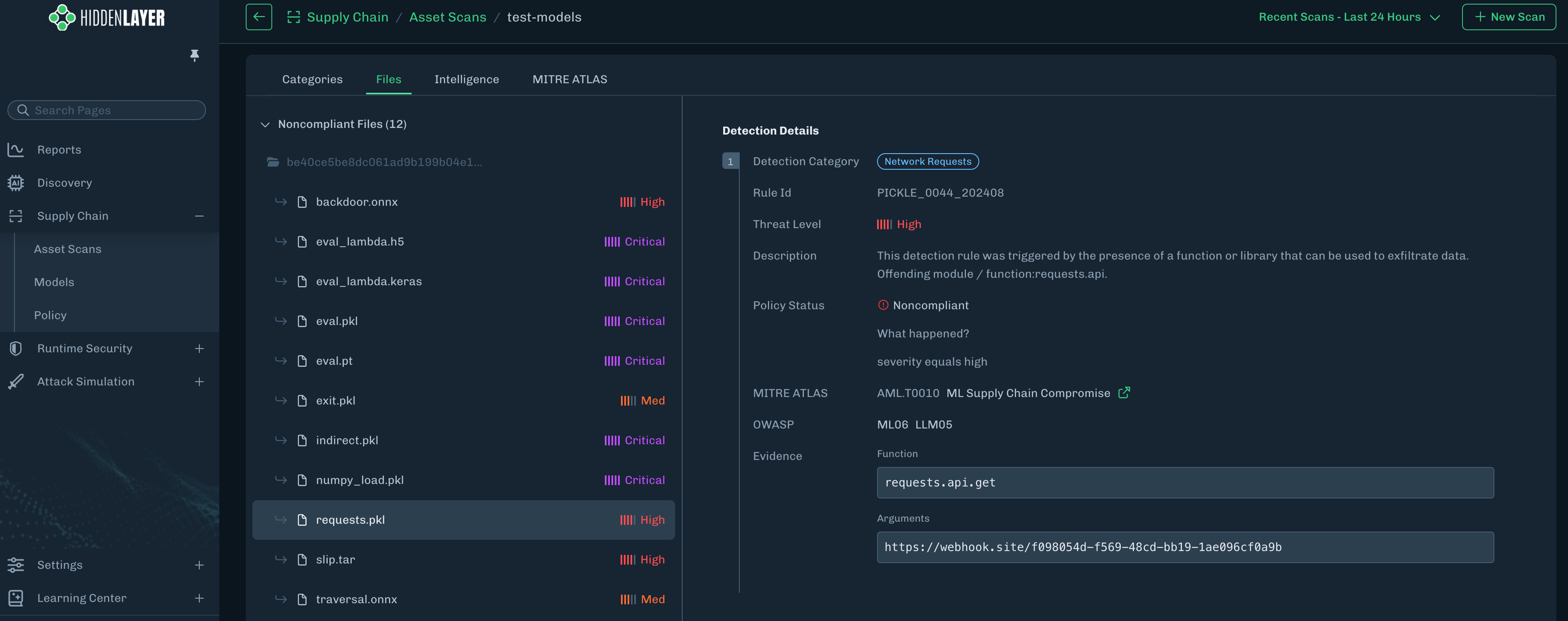
Deliver transparent, context-rich detection evidence across the Supply Chain UI, API, and CLI, to help users immediately understand the cause of alerts, enabling faster triage and paving the way for more sophisticated detection capabilities.
- Provides function and argument details for detections.
- Builds flexible scanner architecture to support evidence for detection rules.
- Integration with Remediation Guidance to provide deeper, actionable detection remediation.
Remediation Insights
-
Provides an in-product, AI-assisted remediation guidance in the Detection Summary to help customers resolve detections quickly and confidently.
- Remediation guidance is generated using AI and ground in an existing, expert-authored remediation guide, then contextualized based on the specific detection category and detection details surfaced in the platform.
- By surfacing AI-assisted, detection-aware remediation guidance directly within the Detection Summary, this provides timely, up-to-date, and relevant decision support while maintaining alignment with HiddenLayer’s detection methodology and customer-specific operating procedures.
Release Notes for Supply Chain version 26.3.0 released on March 4, 2026.
What’s New
Model Intelligence - Country of Origin
- Adds a new field in Model intelligence: Country.
- Country (of Origin) is the geographic region where the model was first posted.
- This enables customers to exclude models based on origin.
Model Card Compliance Override
- The customer now has the ability to override policy at the model level.
- This feature enables customers to create exceptions within the product.
-
The model card menu now contains the 3 additional options:
- Mark as Compliant: Manually set model to compliant
- Mark as Non-Compliant: Manually set model to non-compliant
- Follow Policy: Removes overrides and returns to following Supply Chain policy
What’s Resolved
The following has been resolved with this release:- Fix for community scan errors.
- Applied security patches addressing emergent vulnerabilities in Supply Chain Security.
Release Notes for Supply Chain version 26.2.0 released on February 24, 2026.
What’s New
Remediation Guidance
- Remediation guidance per detection category is now included on the Categories tab on the Scan Details page in the HiddenLayer Console.
- Remediation guidance provides information on how to approach investigating detections within the scan.
- See Supply Chain - Detection Summary for more information.
Policy Configuration via API (Beta)
- Users can now set complex policy via the API that include Geographic Footprint and Licenses as criteria for the policy.
- Requires access to the HiddenLayer API (key and secret).
- This is currently in beta.
- See Supply Chain Policy for more information.
What’s Improved
Model Intelligence
- This release extends Model Intelligence to include the Geographic Footprint where the model was found in repositories, Licenses, and HL Trust level.
-
These new fields will appear under the Intelligence tab on the Scan Details page in the HiddenLayer Console.
- Geographic Footprint - Global search based on SHA that provides the geographic footprint where the model was found in repositories.
- License - Licenses under which the model is governed.
- Trust Level - HiddenLayer’s trust level in the provider of the model used, if available.
- See Supply Chain - Detection Summary for more information.
What’s Resolved
Fixed multi-submit on New Scan slide out
- Fixed the multi-submit issue when selecting Add on the new scan slide out.
- Selecting Add multiple times on the New Scan dialog no longer starts multiple scans of the same model.
Release Notes for Model Scanner version 25.12.2 released on December 22, 2025.
What’s Improved
Support Special Characters in File Paths and File Names
- Adds support for special characters, spaces, and
..in file paths and file names.
Support for TAR and GZIP files
- Enables customers to scan models within TAR and GZIP files.
ShadowLogic Signature for Backdoor
- Adds ShadowLogic signature for Backdoor within IF operator to enhance detections.
Release Notes for Model Scanner version 25.12.1 released on December 3, 2025.
What’s Improved
Increased Detection Coverage
This release provides increased detection coverage when scanning model files.- Added new rules and updated existing rules to improve scanning Pickle files.
- Updated ShadowLogic detections.
Release Notes for Model Scanner version 25.12.0 released on November 25, 2025. This is an early Model Scanner release to support with the upcoming Console release.
What’s Improved
Hosted model deep scans
- Now when a hosted model links to a Hugging Face repository, the repository is scanned.
More genealogy information
- More genealogy signatures so users have a better understanding of their models.
New ShadowLogic detections
- Extending our ShadowLogic detections to cover new attacks.
Release Notes for Model Scanner version 25.11.0 released on November 14, 2025
What’s Improved
Improved the experience when scanning non-model files
- Minor enhancement for the Console UI for Model Scanner to handle scanning of non-model files.
- Users can now submit entire folders with less risk of running into issues.
Support for Non-archived Pytorch Models
- Now scan non-archived pytorch models (an older form of pytorch models).
- Increases coverage of models scanned, including older pytorch versions.
Improved GGUF detections
- Extended GGUF detections to cover new attacks under CVE-2024-34359.
- Improved protection from more complex GGUF attacks.
Release Notes for AISec Platform Console version 25.9.0 released on September 30, 2025.
What’s New
Model Scanner in the Console
- Compliant and Non-Compliant now appear in the UI for policies.
What’s Improved
Model Scanner CLI
- Updated detections, specifically for Safetensor files.
- Removed the deprecated v2 format.
- Bug fixes.
Model Scanner SaaS
- Updated the model upload to support the same name files with different paths.
- Remove deprecated safe/unsafe keywords.
Release Notes for AISec Platform Console version 25.8.0 released on August 26, 2025.
What’s New
Model Genealogy
- Model Genealogy delivers critical insights into model architecture, ancestry, and task alignment to support trust, security, and compliance in AI deployment. Model Genealogy is a Model Scanner feature.
- Model Genealogy is available in both SaaS and hybrid deployments, with support for ONNX and Safetensors formats.
- See the Model Genealogy documentation.
Reporting API
-
Reporting API for Scanned Models with two output formats:
- Paginated JSON for application integration.
- CSV export for bulk analysis and spreadsheet workflows.
Console navigation
- A redesigned left-side menu provides faster access to Model Scanner outputs, including scans, threat levels, AI BOM downloads, and detailed results.
- See the new page here (requires a login): Model Scanner page.
New Graph Payload detections
- Added 2 new Graph Payload detections for ONNX files.
What’s Improved
Add Scan
- Add Model has been renamed to New Scan for improved usability.
General improvements
- General improvements to stability and reliability.
Release Notes for Model Scanner Enterprise v25.7.0 release on July 29, 2025.
What’s New
Console UI
- Improved visibility of file errors encountered during a scan.
What’s Improved
- Detection updates for Pickle files.
- Additional signatures for the Graph Payload detection category and Genealogy.
- Bug fixes. Plus, resolved spikes in memory usage for certain ONNX files.
Release Notes for Model Scanner Enterprise v25.6.0 release on June 26, 2025.
What’s New
Hybrid Deployment for Self-Hosted API
-
The Model Scanner Self-Hosted API (formerly Model Scanner Enterprise) can be deployed in Hybrid Mode.
- Hybrid Mode sends Model Scanner results to the AISec Platform and is visible in the Console.
-
Scan Source in Model Scan Details
-
Model Scan details now include information about the Origin and the Request Source.
- Origin: The source of the model file. Examples: Hugging Face, internal repository, or Local file system.
- Request Source: How the scan request was initiated. Example: UI upload.
-
Model Scan details now include information about the Origin and the Request Source.
What’s Resolved
- This release also includes bug fixes and performance improvements.
Release Notes for Model Scanner Enterprise v25.5.0 release on May 20, 2025.
What’s New
AI Bill of Materials (AIBOM)
- Designed to address critical challenges in AI supply chain security.
- AIBOM provides an inventory of AI artifacts for every scanned model in an industry-standard SBOM format, empowering security and data science teams to track AI components, vulnerabilities, and ensure compliance with regulatory standards.
- Available in SaaS, Model Scanner CLI, and Model Scanner Self-hosted (CLI+Orchestrator).
- Includes coverage for pyrepl, venv, and ultralytics functions, which can be used to execute malicious code.
Model Scanner CLI Hugging Face Repository URL
- Model Scanner CLI now accepts a Hugging Face repository URL and token for access to private or gated repositories.
- Files in the repo are automatically downloaded and scanned.
Installation for Non-Admin Users
-
For users who do not have admin access to the Kubernetes cluster, HiddenLayer provides an option to install with a lower privilege user into an existing namespace.
- See the Model Scanner API Deployment Guide for more information.
Release Notes for Model Scanner Enterprise v3 v25.4.0 released on April 24, 2025.
What’s Improved
Detection Updates
-
Pickle File Format detections are now classified as Critical.
- Added coverage for
pyrepl,venv, andultralyticsfunctions, which can be used to execute malicious code.
- Added coverage for
-
Coverage for new Control Vector attacker technique under the Model Backdooring category.
- Inserted control vectors can control or modify model behavior as well as can be used to remove refusals on a secured model.
-
Keras File Format
- Added detection for CVE-2025-1550, a vulnerability in Keras that allows attackers to execute arbitrary code during model loading, even when safe_mode=True. This exploit leverages the deserialization process of .keras model archives, specifically targeting the
config.jsonfile within the archive.
- Added detection for CVE-2025-1550, a vulnerability in Keras that allows attackers to execute arbitrary code during model loading, even when safe_mode=True. This exploit leverages the deserialization process of .keras model archives, specifically targeting the
Release Notes for Model Scanner Enterprise v3 v25.3.0 released on March 26, 2025.
What’s New
Model Scanner V3 Output
- Model Scanner outputs the V3 schema format by default.
V2 SchemaThe v2 schema output is no longer supported.
Community Scan
- You can now scan a model directly from a public repository on Hugging Face by specifying the repo URL.
- HiddenLayer will automatically download and scan the model.
Private or Gated Hugging Face RepositoriesPrivate or gated Hugging Face repositories are not supported at this time.
New Detections
- Repository Sideloading: Detects instructions in the config.json file to load code or model artifacts from a location that bypasses checks performed on the artifacts in the repository.
- Pickle File Format: New rules detect risks specific to serialized .pkl files.
- Graph Payload: Introduced three new detection rules targeting this attack technique.
What’s Improved
Severity Level Updates
-
Arbitrary Code Execution detections are now classified as Critical.
- Why this matters: Arbitrary code execution (ACE) attacks are relatively easy to perform and can lead to serious consequences, such as executing malicious code within organizational systems. When a scan identifies a malicious file, it’s treated as a Critical vulnerability, indicating potential intent to load it—creating a risk of remote code execution (RCE).
- Recommended Action: Avoid using any model flagged for ACE to mitigate security risks.
-
Additional detection severity reclassifications have been made to align with the HiddenLayer Vulnerability Risk Taxonomy. Also see the Model Scanner Detection Categories article.
- Embedded Payload: Medium → Low
- Suspicious Functions: Medium → High
- Suspicious File Format: Low → Medium
CLI Detection Output Updates
-
The risk field has been removed from the Model Scanner CLI output. Use the severity field to assess organizational risk.
- Updated
schema_version: 3.2.0
- Updated
Enterprise Architecture Update
- Self-Hosted Model Scanner Enterprise V3 now supports Azure and AWS deployments.
V2 Model Scanner EnterpriseThe v2 Model Scanner Enterprise architecture (which bundled API and Worker in a single distro-enterprise-modelscanner image) is no longer supported.Action Required: Upgrade to the V3 architecture for continued support and enhancements.
Release Notes for Model Scanner Enterprise v3 v25.2.0 released on February 19, 2025.
What’s New
Self-Hosted Enterprise V3 - Now Supports Azure
In addition to AWS, you can now install Model Scanner Self-Hosted Enterprise V3 on Azure using our easy-to-use installer.Console UI Improvements
Detections All - Model Scanner- New Filters – Quickly sort and prioritize detections with filters for Date and Scanner Versions
- Model Deletion – You can now delete model cards from the inventory.
Fewer Unsupported File Status Errors
Model Scanner now recognizes but does not scan the following common file types:- Documentation:
.md(READMEs, release notes) - Code Files:
.py(scripts),.js(optional),.sh(shell scripts) - Config/Metadata:
.json,.yaml,.yml,.ini,.cfg - Data Files:
.txt,.csv,.tsv - Git Config Files:
.gitignore,.gitattributes
What’s Improved
Performance Optimizations
Memory usage has been optimized for all file types by eliminating MD5, SHA1, and TLSH hash calculations.Detection Updates
Expandedtar file detection – Now applies Zip Slip vulnerability checks to all files typed as tar.Release Notes for the latest Model Scanner v25.1.0 released on February 6, 2025.
What’s New
Detections All - Console
A Detections All view for Model Scanner in the Console UI.What’s Improved
Performance Optimization
- Memory usage for Skops file scanning has been reduced from 10x to 0.03x the file size, resulting in a 250x improvement in efficiency.
- Memory usage for NumPy file scanning has been reduced from 1x to 0.023x the file size, resulting in a 61x improvement in efficiency.
- The throughput for PyTorch and NeMo file scanning has increased by 2x.
Detection Updates
Improved detection accuracy for zip-type files, whether they contain random files or specific model types that use zip or tar as a container format (e.g., PyTorch, NeMo, Skops, NumPy, Keras, TensorFlow, or SafeTensors).Release Notes for the latest Model Scanner v24.12.0 released on December 17, 2024.
What’s New
Model Scanner License
HiddenLayer now provides a Model Scanner license.Model Scanner Hybrid Deployment
A Model Scanner hybrid deployment where the user can run the Model Scanner CLI in their environment while still enjoying the benefits viewing the results in a user-friendly interface, the AISec Platform Console.Skops Files
- Model Scanner can scan and detect vulnerabilities in Skops files.
- The Skops file type (.skops) is SciKit Learn’s recommended secure file format.
FIPS-Compliant
Model Scanner container images are now FIPS-compliant, ensuring compatibility with systems adhering to Federal Information Processing Standards (FIPS) requirementsModel Scanner Output - Version 3
The default output format of the Model Scanner CLI is version 3. To preserve the version 2 output format, use —output-format v2 in the CLI command.What’s Improved
ONNX
Improved memory usage for ONNX.Default Output Format
Updated the default output format in the Model Scanner CLI to v3.Pickle
Added coverage fornumpy.f2py.diagnose.run_command.Release Notes for the latest Model Scanner v24.10.2 released on November 6, 2024.
What’s Improved
Improved handling of multi-file archives
- ZIP files are now uncompressed and scanned up to three levels deep. Detection details for each file within the zip archive are accessible in the SaaS UI or via the v3 output in the Model Scanner CLI, allowing users to explore detailed results.
- If the archive file is in a supported format, such as PyTorch, it is uncompressed and scanned, and all relevant details and detections are reported at the main file level.
What’s Resolved
- Resolved an issue where files were incorrectly flagged with detections meant for other file types. Detections are now accurately matched to the correct file types, reducing false positives.
- This release also includes bug fixes.
Release Notes for the latest Model Scanner v24.10.1 released on October 24, 2024.
What’s New
ONNX Detections
Detections for suspicious payloads and potential backdoors in ONNX computational graphs. These detections are based on insights from a ShadowLogic blog post.What’s Improved
Pickle Format
Improved Pickle format introspection and detection accuracy.What’s Resolved
This release also includes bug fixes.Release Notes for the latest Model Scanner v24.9.1 released on September 30, 2024.
What’s New
Detection Risk Context
Each detection now includes enhanced risk information, such as:- Detection Category: Identifies a detected adversarial technique, can help classify and understand the nature of the threat
- Severity: Critical, High, Medium, or Low
- MITRE Atlas: Technique and tactic mapping
- OWASP: Top 10 ML/LLM mapping
- CVE Number: (if applicable)
Detection Updates - New Detections for Pickle
New detections have been added for three additional functions that could be exploited to execute arbitrary code.Release Notes for the latest Model Scanner v24.9.0 released on September 17, 2024.
What’s New
Detection Risk Content for Unsafe Models
Expand the usage of the SARIF format to help users understand and analyze model scanner results.What’s Improved
GGUF Memory Improvements
Improved memory usage when scanning GGUF files.Release Notes for the latest Model Scanner v24.8.0 released on August 20, 2024.
What’s New
GCP Self-Hosted Deployment
Self-Hosted deployment for the Google Cloud Platform (GCP).SARIF Format Output
Translate API v2 output to the Static Analysis Results Interchange Format (SARIF) format, a standard format for the output of static analysis tools.Release Notes for the latest Model Scanner v24.7.0 released on July 23, 2024.
What’s New
Redis TLS Connection
The Self-Hosted Enterprise Model Scanner now supports a Redis TLS connection using a TLS certificate when connecting an existing Redis instance to the Model Scanner. This allows you to maintain adherence to your security protocols.This is available for the Model Scanner Enterprise Self-Hosted.GGUF Model
The Model Scanner supports the GGUF model format. GGUF is a binary format for distributing trained machine learning models.Detection Updates
The Model Scanner now includes the following detections:- GGUF - CVE-2024-23496: a heap-based buffer overflow vulnerability in the gguf_fread_str function of llama.cpp (commit 18c2e17) allows remote code execution through specially crafted GGUF files.
- GGUF - CVE-2024-34359: a weakness in Jinja2 that can lead to arbitrary code execution through malicious chat_template within a GGUF model file’s metadata.
- ONNX - CVE-2024-27318: a path traversal vulnerability that can lead to arbitrary file read.
- Pickle: detections for four additional functions that can be used to execute code.
What’s Resolved
This release also includes performance improvements and bug fixes.Release Notes for the latest Model Scanner v24.6.0 released on June 20, 2024.